The Journal · 26 September 2026
Staying with Nomads: A Guide to Yurt Camps in Kyrgyzstan
Explore Orient Editorial
The Journal · 26 September 2026
Explore Orient Editorial
There’s a particular quality to silence at 3,000 metres, broken only by a horse cropping grass outside the felt wall and a kettle finding its boil on a dung-fire stove. Most travellers who write about staying in a Kyrgyz yurt camp settle on the same rough figure — a night or two, sometimes stretched to three, is the commonly reported length of a typical stay at the high pastures, a pattern echoed across general Central Asia tourism writing rather than any single official count. It’s enough time to stop performing ‘visitor’ and start living at the pace of the family whose guest you are.
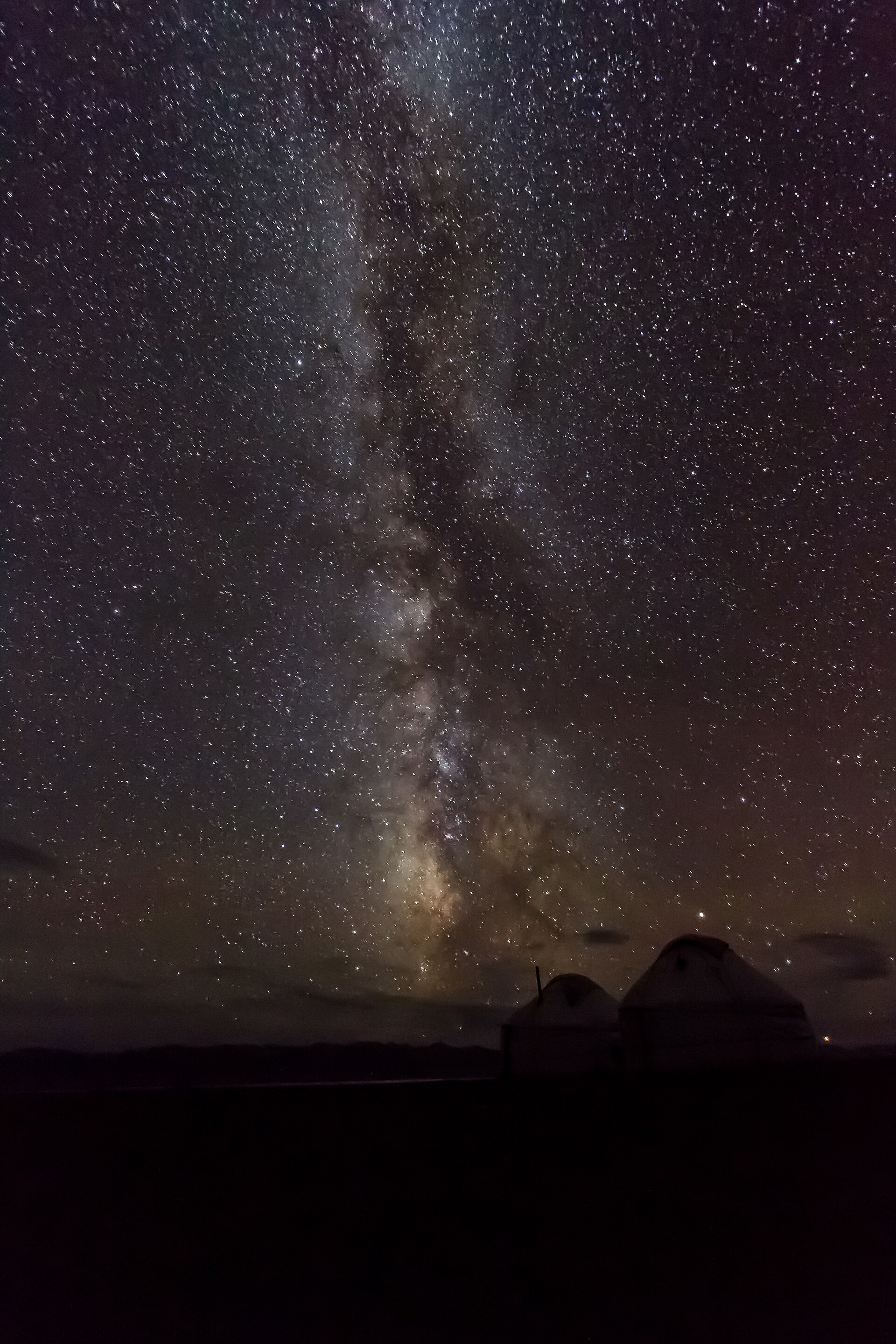
A yurt itself is simply built and beautifully engineered for its purpose: a circular lattice frame, felt walls layered against wind and cold, and a crown of open sky at the centre — the tunduk — that doubles as a smoke vent and, on a clear Kyrgyz night, an astonishing window. Sleeping is communal in the traditional sense: thick quilted mats and heavy blankets laid directly on the floor, arranged around a low stove that a member of the family will stoke through the night if the air turns properly cold. Bathrooms are outbuildings, sometimes a short walk away; you wash with a jug and a basin rather than a shower.
Meals follow the rhythm of the herd rather than a menu. Expect flatbread baked that morning, fresh dairy — kaimak, yoghurt, sometimes kumis, the fermented mare’s milk that nomadic households take pride in — and a hearty broth or noodle dish built around whatever the family has to hand. Days with a herding family move around the animals: an early start to move the horses or sheep to fresh grazing, an afternoon that might include a riding lesson pitched to your ability, and an evening spent, more often than not, simply talking through a shared cup of tea as the light goes long over the pasture.
The most storied yurt country sits around Son-Kul (you’ll also see it written Song-Kol — both spellings circulate and refer to the same alpine lake), a broad glacial basin in the Tian Shan where camps cluster along the shoreline through the brief window the grass is green. Beyond Son-Kul, smaller camps thread through the wider Tian Shan foothills — the approaches around Kochkor, the valleys near Karakol — offering a gentler, lower-altitude version of the same experience for travellers short on time or altitude tolerance. Explore Orient’s own Nomad Summer itinerary threads exactly this ground, from Bishkek through Burana to the Song-Kul pastures and on to Issyk-Kul and Karakol, and it remains the most direct route into a genuine yurt stay if you’d rather not assemble the logistics yourself.
High-altitude camps at Son-Kul are a short-season proposition. The road up is only passable, the grass only grazeable, and the families only in residence, roughly from June to September — a window widely cited across Central Asia travel sources for high pastures at this elevation, though exact opening and closing dates shift year to year with snowfall and road conditions. Outside that window the lake basin empties out entirely and camps come down for the winter, so a yurt stay here is very much a summer plan, not a year-round one.
Son-Kul sits above 3,000 metres, and the thing that catches most first-time visitors off guard is the temperature swing rather than the altitude itself: a warm, even hot, early afternoon can drop to near-freezing after dark, all inside the same 24 hours. Pack proper layers — a genuine insulating layer for the evenings, not just a light jumper — along with a headtorch, since camps run on generator or none at all after sundown, and something to cover your head against strong daytime sun at elevation. Facilities are basic by design: pit toilets, jug washing, no power sockets in the yurt itself. That’s the trade for waking up to a lake the colour of hammered pewter with nothing but grazing horses between you and the horizon.
A note on custom rather than comfort: staying with a herding family means staying inside their household norms, which in rural Kyrgyzstan can extend to modest dress, how photographs of the family are taken and shared, and expectations around unmarried travellers sharing a yurt. These are matters of local practice that shift with the family and the season, so it’s worth confirming current expectations — and any formal entry requirements for your nationality — directly with an official source or with us before you travel, rather than assuming.
For travellers who want the yurt experience built into a wider Kyrgyzstan itinerary rather than arranged piecemeal, our Nomad Summer tour is the cleanest route in — eight days moving between Bishkek, Burana, the Song-Kul pastures and Issyk-Kul, with the horseback days and yurt nights at its centre. It also sits naturally within a broader look at the country on our Kyrgyzstan destination page, or as one leg of The Five Stans for those covering more of Central Asia in a single sweep. Specific camp names, exact departure dates and what’s included on any given trip are available on enquiry — the families and pastures we work with can vary by season, and we’d rather confirm the current arrangement with you than promise one in advance.
Photo: Benjamin Goetzinger, CC BY-SA 4.0, via Wikimedia Commons
The Caravan Letter
No noise. One considered letter on where to go in the Orient and when, written by the people who plan these journeys.
